Planting the future

Planting the future

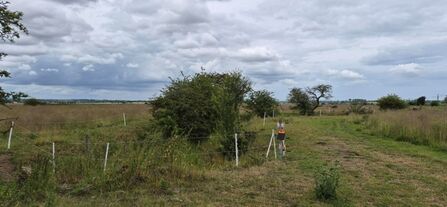
Heading out to plant at Ricknall Carrs, part of a huge team effort from staff and volunteers alike. 

A seed's journey across the Great North Fen.

Follow a single seed and you will find yourself walking the whole story of one of our most recent Great North Fen projects ‘Planting the Future’. It begins in one of the last remaining fragments of ancient wetland in County Durham, survives a journey through filing cabinets, greenhouses and university laboratories, and ends up back in the wet earth it came from, part of a wetland taking shape again after two hundred years away.

The Great North Fen

The Great North Fen is Durham Wildlife Trust's boldest ambition yet: to restore the lost wetlands of the historic Durham Carrs, an 800+ hectare mosaic of habitat we aim to have brought back to life by 2042 and beyond. From the mid nineteenth century onwards, this land was steadily drained for farming, its channels deepened and its ditches dug until the water that once defined the landscape had all but disappeared. 

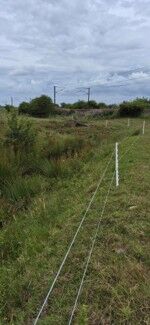
A rural field with a shallow ditch containing water and green vegetation. White posts with thin wires form a fence across the area, and a small brick and wooden structure sits near the ditch. In the distance, cattle graze on open farmland beneath a cloudy sky, with power lines running along the right side.

The Great North Fen today: protecting newly plugged plants and giving them time to establish! 

Bringing it back is a project measured in decades. But every long journey is made up of small steps, and the next one starts with a single question: where do you even find a wetland plant that has not grown wild in County Durham for generations? 

A fragment that survived 

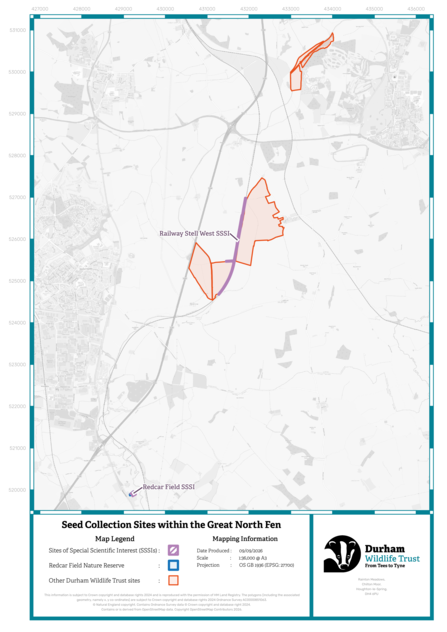
The answer lies in a handful of places that have stood the test of time. Two of them, Railway Stell West and Redcar Field, are protected as Sites of Special Scientific Interest, or SSSIs, one of the strongest legal protections a wildlife site can hold in this country. Tucked into narrow, overlooked corners of the landscape shown below, they still hold the plant communities that once covered the whole of the Carrs.

Think of these fragments as a living seed bank, the last copies of a book that has otherwise gone out of print across the county. Everything that follows in this story starts with what survives in these few protected hectares.

Collecting the seed

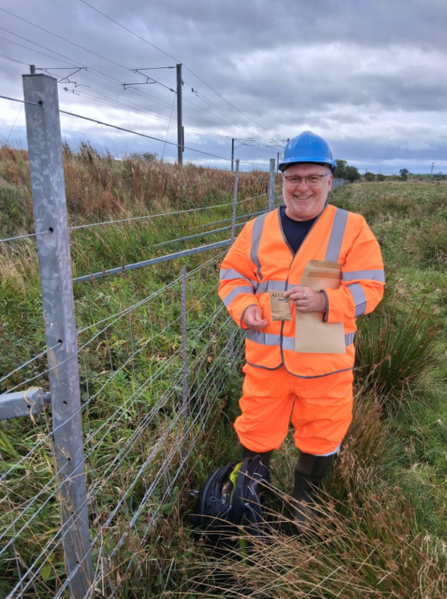
Turning that fragile seed bank into a real one has been led, in large part, by Mandy Walker, a former and most fabulous Durham Wildlife Trust trainee, who has worked closely with Durham University throughout this project, out on the SSSI collecting seed under all the necessary permissions.

It is careful and patient work: identifying the right plant at the right moment, gathering just enough seed to propagate without damaging the wild population, then labelling and dating every single collection by hand. Species gathered so far include common meadow-rue, water whorl-grass, lesser water-parsnip, water violet and tubular water-dropwort, all locally rare and nationally declining, plus a happy surprise along the way: a remnant gypsywort plant found growing wild near Railway Stell.

   A blue metal filing cabinet with several drawers open, each containing neatly organized brown paper envelopes labeled “SEEDS.” The envelopes have handwritten details such as seed names, dates saved, and growing notes. The setup suggests a well‑maintained seed archive or collection system used for gardening or conservation.

Seed collected from Great North Fen remnant sites, labelled and stored by hand ready for propagation.

For Mandy, and for the traineeship programme that gave her this start, it is exactly the kind of hands-on, skills building work that keeps the Great North Fen moving forward, one seed packet at a time.

From seed to seedling

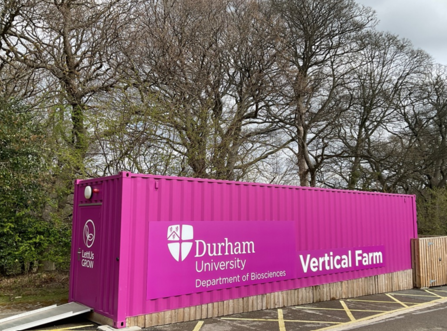
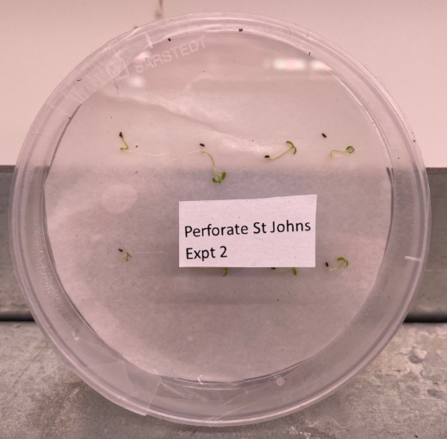
Once collected, the seed makes the journey to Durham University, and this is where the science takes over. Cold treatment, sowing and germination trials, including roughly 900 petri dishes each testing a different combination of conditions, happen at the university's Biosciences vertical farm, a converted shipping container doing some of the most delicate work in the whole project.

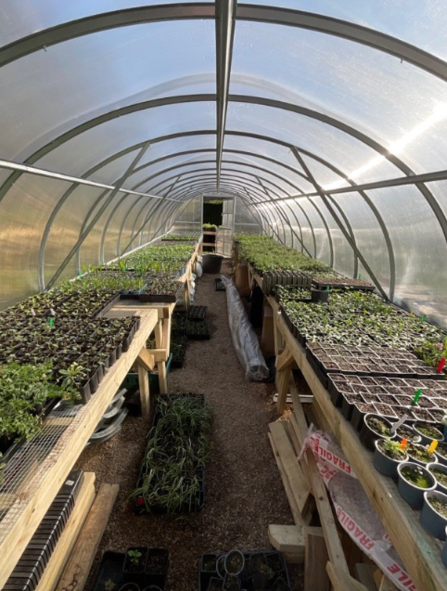
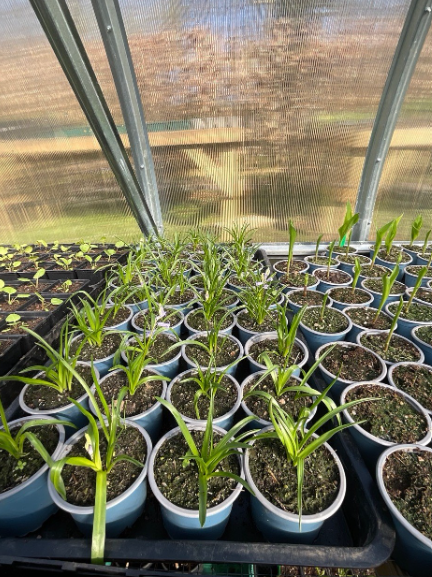
From there, the seedlings graduate to a network of growing on sites: a polytunnel and greenhouse at the Botanic Garden, space at Mountjoy Farm, and an outdoor compound where young plants are hardened off before they are ready for anything the Great North Fen can throw at them.

Once hardened off, these seedlings are finally ready to leave the nursery behind and complete the journey back to the fen.

Planting back out, together

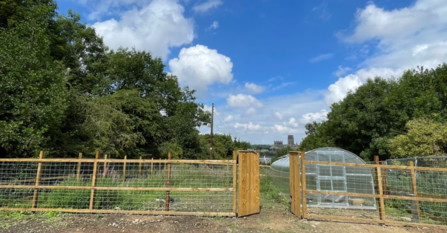
Eventually, every seedling reaches the last leg of its journey: the trip back to the wet ground it came from. This part has been a genuinely huge team effort. Durham Wildlife Trust staff, volunteers and even corporate visitors have turned out for planting days at Ricknall Carrs, working along the boggy margins of old field drains to tuck plug after plug into the ground by hand.

In July 2026 alone, Durham University supplied 1,682 plug plants ready for planting, with a further delivery of around 2,000 plants due ahead of another planting session this October. Among the species going back into the ground are:

  • Common meadow-rue and greater tussock sedge
  • Valerian and meadowsweet
  • Water mint, water figwort and water forget-me-not
  • Yellow flag iris and devil's bit scabious
  • Cuckoo flower and greater birdsfoot trefoil
  • Woody nightshade, redshank and hemp agrimony
A grassy field with scattered trees under a cloudy sky. A narrow dirt path runs through the grass, bordered by a white wire fence. A few people walk in the distance near the left side, and the scene feels open and rural.

Heading out to plant at Ricknall Carrs, part of a huge team effort from staff and volunteers alike. 

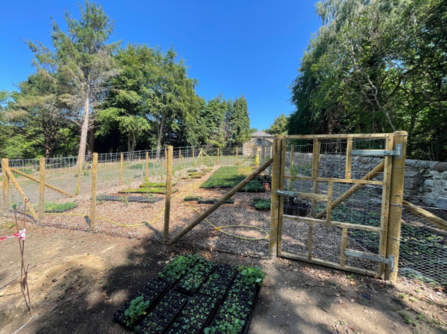
New electric fencing now protects these planted compartments, controlling grazing so that every plug plant gets a fair chance to establish before the sheep move back through!

Involving people matters just as much as the planting itself. Members of the public who come onto our reserves help us understand what species are already thriving and what might still be missing, turning every guided walk and volunteer day into a hands-on contribution to nature's recovery, not just an afternoon out.

How this supports wetlands

So why go to all this trouble for tiny seedling plants? Because the plants are the wetland. The species collected from Railway Stell West are not simply wetland specialists that need boggy ground to survive. Many of them actively help build it, and it is a neat trick of nature worth explaining. Dense, fibrous root systems slow the flow of water across the land and bind the wet soil together, while sediment settles out around their stems instead of washing downstream. Every autumn, as their leaves and stems die back, they add another layer of organic matter to the ground beneath them, the same slow process that builds peat over time. Planting them back out in quantity at Ricknall Carrs does more than give these species somewhere to live. It recreates the physical conditions a much larger wetland needs to take hold, and gives each plant community a growing point from which it can spread naturally into the surrounding ground.

Wetlands built this way are among the best habitats we have for locking away carbon and reducing flood risk, and they create homes for species that have become scarce across Britain, among them otter, water vole, curlew and lapwing. Re-established native vegetation also filters pollutants, stabilises banks and helps the interconnected River Skerne run cleaner as a result.

A small orange and black butterfly rests on a pale purple flower surrounded by dense green leaves. The butterfly’s wings are open, showing black spots and edges, while the flower sits among other buds and stems. The scene captures a close-up of natural pollination in a lush garden or meadow setting.

A small skipper butterfly on valerian, one of many species drawn back in as the wetland flora returns.

The Great North Fen sits in a tight spot, sandwiched between the East Coast Main Line and the A1(M), so every change to water levels has to be carefully managed. Collaborating with Northumbrian Water and others is therefore key when it comes to restoring nature, giving back to the community and saving water in the natural environment.

Every seed Mandy collects, every petri dish Durham University fills, and every plug plant a volunteer tucks into the ground at Ricknall Carrs is a small step towards that large mosaic of restored wetland, and towards the national target of creating or restoring 500,000 hectares of wildlife rich habitat across the country. Planting the Future has been made possible with support from Northumbrian Water's Branch Out Fund, the Environment Agency's Water Environment Investment Fund, CrossCountry, Ashcourt LCF, alongside the continued partnership of Durham University.

Restoring wetlands across the Great North Fen

If you would like to see the work in person, join one of our guided walks, or get in touch about volunteering at Ricknall Carrs and across the wider Great North Fen, please see our upcoming events or contact us via mail@durhamwt.co.uk.