From pit to wildlife paradise: breathing new life into Hazard Railway

From pit to wildlife paradise: breathing new life into Hazard Railway

Volunteers at Hazard Railway

What started as a clearance cut beneath a powerline at Hazard Railway quickly became a chance to do something bigger: reshape a bramble-choked woodland corridor into a richer space for wildlife. Staff, trainees and volunteers worked together to bring this site back to life. Hear all about what took place in this blog, by Conservation Trainees, Jonathan Phillips and Mandy Walker.

East of East Rainton, but not quite so east you reach Hetton-le-Hole, Links with Nature has been making great strides for nature at Hazard Railway. The site of a former pit that closed just shy of one hundred years ago, it is now a woodland used extensively by visitors for strolls and dog walking. Despite being in close proximity to farmland and housing, it has a tranquil feel and is a refuge for urban wildlife.

When a clearance cut was done to open space beneath the powerline that runs through this woodland, we saw an opportunity to intervene. Inspired by past projects transforming overlooked and disused spaces into wildlife havens, we set about creating and implementing a plan that has now transformed an overgrown corridor of scrub and bramble, into a wide variety of habitats that will attract and benefit a range of ecologically diverse species. 

 A person in a dark blue shirt stands at the edge of dense woodland, holding a clipboard and pointing toward the trees as if conducting fieldwork or an environmental survey.

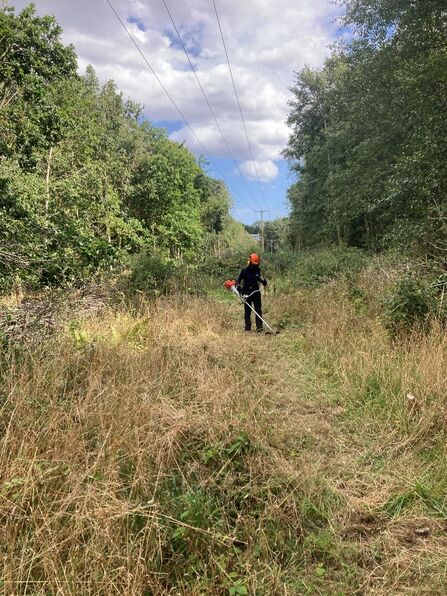
Beginning in late August 2025, the team of Durham Wildlife Trust staff and volunteers were met by an almost jungle like vista as already alder regrowth was swallowing up light to starve out the woodland underlayer, and bramble patches had begun sending out questing thorny tendrils, scouting the next expansion of their tangled sprawl. Despite the rather intimidating sight, the team remained undaunted and quickly cut a path through the length of the ride to allow access for future site reconnaissance and tasks. 

From this headland we carved (with no small amount of effort). We could then begin on the main focus: the creation of woodland scallops. Now, before you ask, no, when I previously mentioned ‘ecologically diverse species’ I wasn’t stretching quite as far as the sea. Woodland scallops are semi-circular ‘scoops’ cut into a woodland edge, thereby increasing the surface area of a band of space that acts as the transition point between the woodlands exterior and interior. This offers an immediate benefit as the band is the most ecologically diverse of the entire woodland and so by increasing it, we also increase the woodland’s diversity. But specifically in the case of a ride, these scoops give the ride a softer, meandering edge with additional pockets of protection from the wind that would otherwise race unimpeded down the corridor. 

Within these scallops, we raised the crowns of neighbouring trees, allowing yet more warming light in to reach the woodland floor. This, now cleared and bare, was sown with a woodland edge seed mix to increase floral diversity and resources for pollinators.

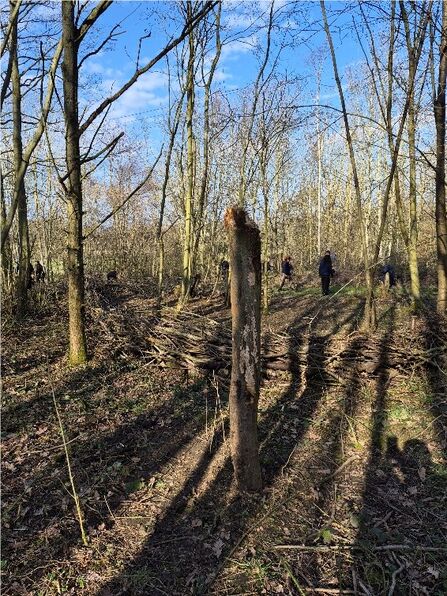
The cleared material that had been left where it fell has been repurposed with the creation of dead hedges that line the scallop edges, acting as sun traps perfect for bees and butterflies, or the perfect nesting spot to inhabit for birds or small mammals, or even just acting as the ideal perch for taking a moment to rest and warm themselves. Aesthetically pleasing dead hedges were also installed at either end of the ride to narrow the entrances, further reducing wind flow and to prevent access by vehicles, thereby reducing disturbance from anti-social behaviour and fly-tipping. Previously fly-tipped waste was removed with the assistance of 'Clean it Green it'.

A grassy path runs through leafless woodland, with piles of cut branches along one side and a few people working near power lines in the distance under a grey, overcast sky.

Hazard Railway dead hedges

Larger logs were taken and cut to a reasonably manoeuvrable size before being drilled with several holes of different depths and widths, before being dug into the ground so they would stand upright. These logs are now a powerhouse of potential, offering nesting habitat for anything from willow-tit, to solitary bees, beetles and a whole host of species in-between, and that’s not even including the possibilities for fungi, that will then create even further resources that can attract more wild visitors.

As our traineeship began to draw to a close, we decided to go all out and give the project a send-off we could be proud of – we joined forces with Heart of Durham Project Officer, Laura Tedstone, and her team of seasoned volunteers.

A group of people walk along a muddy woodland trail between tall, leafless trees on a sunny day, wearing outdoor clothing and backpacks.

Volunteers at Hazard Railway

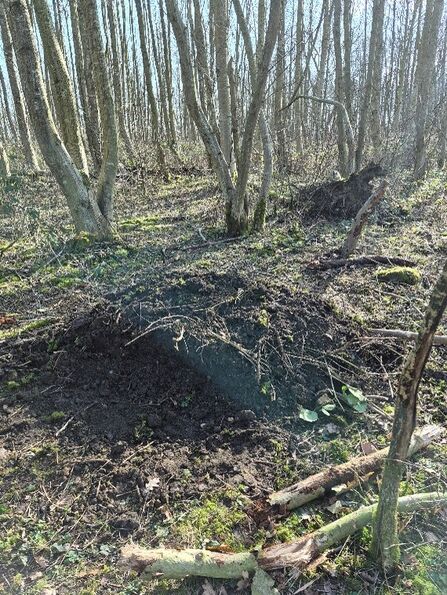
This bringing together of workforces saw us introduce a hibernaculum: digging down into the ground and positioning logs and brash which was then covered with soil. This mound would provide gaps perfect for amphibians and invertebrates to burrow into with a steady ambient temperature to escape extreme temperatures.

Scrapes were dug into the woodland floor, encouraging small areas of standing water to collect for dragonfly and newts to breed. Yet more standing dead wood was introduced and drilled in the surrounding area.

But, anyone who has worked on a project such as this will know that it is hard to say goodbye. The temptation to keep up the good work is too much! As I write this, I am looking forward to re-joining the Links with Nature team, this time as a volunteer, to return to Hazard and create a larger scrape, the removed soil then to be used to create a bund, or bank, not only helping to retain water but offering a bare soil incline, perfect for ground nesting bees and other invertebrates to make it their home. 

Now that spring is upon us, the bees and bugs are emerging, the birds are beginning to nest and the trees are in bud, I am eager to return again, perhaps this time without loppers and saws, but just to meander down the ride, looking to see who may have already taken up residency in the newly created habitats. 

Transforming the site has had a huge impact, one I hope we can perhaps measure with counts or surveys in the future. As trainees, however, the experience of taking on and managing a project like this, and the sense of ownership and pride over what we have achieved is beyond measure.
Jonathan Phillips
Conservation Trainee
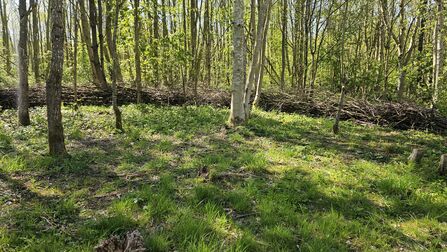
A small woodland clearing with thin trees and fresh spring growth. The ground is grassy with a few cut stumps, and dense green shrubs fill the background. Overhead, several power lines cross a bright blue sky.

Hazard Railway wildlife corridor in spring after the works